410 Santa Maria, Irvine, CA 92606
E-mail us: [email protected]
24 Hour Service - 7 Days a Week

Understand common Wolf error codes and service messages affecting ovens, ranges, gas cooking equipment, and electric or induction cooktops, with guidance on possible causes.
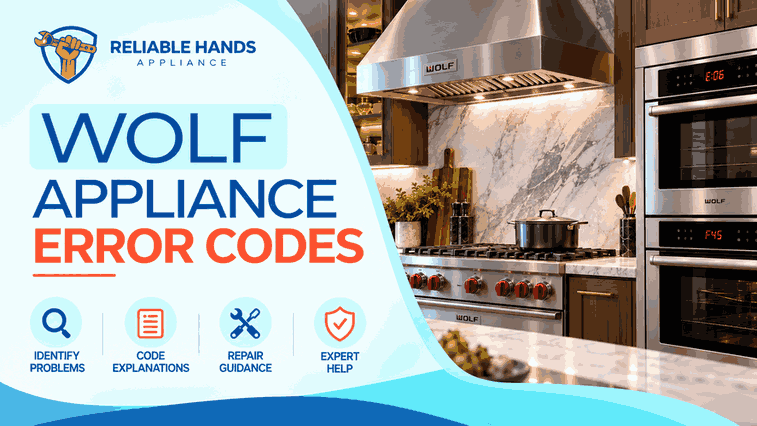
Wolf has produced several generations of ranges, wall ovens, induction cooktops, steam ovens, and warming drawers. Diagnostic formats vary, so the same style of code should not automatically be applied to every model.
Wolf appliances use advanced controls, temperature sensors, cooling systems, heating components, and safety circuits. When the electronic control detects a problem, the appliance may display an error code, warning message, or diagnostic number.
Wolf has produced several generations of ranges, wall ovens, induction cooktops, steam ovens, and warming drawers. Diagnostic formats vary, so the same style of code should not automatically be applied to every model.
Record the complete error and model number before attempting to interpret it.
ERR 01 means the oven control did not detect the door-lock or unlock switches within the expected time while operating the lock motor.
This can interfere with functions such as self-cleaning.
0B or E11 identifies an analog-to-digital calibration error. Wolf recommends a brief power reset as the initial external step.
COMM ERR means communication with the oven controller has been lost.
ERR 00 can indicate that the range has entered diagnostic mode or that there is an issue involving the electronic control-head touch pad.
Current Dual Fuel ranges use detailed four-character codes.
0222 identifies a shorted bake-element DLB relay on the applicable oven circuit.
3C20 means the control has detected high incoming voltage.
5522 indicates that a secondary cooling fan is operating below the expected minimum speed.
These codes are model-specific diagnostics rather than universal Wolf fault definitions.
Wolf Induction Ranges monitor touch controls, induction generators, electrical conditions, fans, and oven components.
E01 identifies a key error involving the left secondary control.
E40 indicates a generator hardware synchronization problem.
4531 identifies a shorted right convection fan.
5522 indicates a stalled secondary cooling fan.
If the induction surface repeatedly stops heating or returns the same error after an approved power reset, professional electronic diagnosis may be needed.
One of the clearest wall-oven messages is PROBE SHORTED, which Wolf identifies as a temperature-probe fault.
First confirm that the probe is fully seated in its receptacle. If the message remains, the probe or related circuit may require repair.
4A10 identifies a stalled lower cooling fan on applicable E Series ovens.
Cooling-fan faults require attention because the fans help manage internal equipment temperature.
Legacy CT induction cooktops use codes including E8, E9, E10, E13, E31, E34, and E53.
E8, E9, and E10 are communication faults involving individual induction generators and the control system.
E13 identifies a universal OFF-key failure and may sometimes occur when moisture is present around the controls.
E31 and E34 concern burner-indicator electronics.
E53 identifies a shorted heat-sink thermistor.
Repeated internal induction faults should not be treated as DIY electrical repairs.
Some Wolf Convection Steam Ovens use paired codes.
E10 with F0 concerns cooking-space temperature sensing.
E18 with F1 involves the food probe or connection.
E44 with F7 can involve the boiler heating system, temperature protection, scale buildup, sensors, or related steam-generation hardware.
E87 with F4 concerns the exhaust slide valve or motor.
E103 with F31 identifies incompatible communication between the relay board and control board.
10 indicates an incorrect checksum in the electronic control.
40 is an element-sensing error that appears when expected temperature rise does not occur.
50 concerns the drawer door switch.
60 indicates an excessive-temperature condition.
Record the entire code and note what the appliance was doing at the time.
Wolf recommends a brief breaker power reset for many products. If the code returns, avoid repeatedly clearing it or replacing components based only on the code.
Electronic controls, wiring, sensors, fans, heating components, and power conditions can produce related symptoms.
For professional Wolf appliance diagnostics and repair, contact Reliable Hands Appliance.
Phone: +1 (714) 338-9438
Email: [email protected]
Office Hours: Monday through Friday, 7:00 AM to 7:00 PM
Saturday: 9:00 AM to 6:00 PM
Sunday is reserved for emergency calls. Call to confirm availability.
Office: 410 Santa Maria, Irvine, CA 92606
Time Zone: Pacific Time

