410 Santa Maria, Irvine, CA 92606
E-mail us: [email protected]
24 Hour Service - 7 Days a Week

Reliable Hands Appliance repairs commercial washers with filling, washing, draining, extraction, door-lock, control, payment-system, leak, and vibration problems.
Reliable Hands Appliance provides professional commercial washer repair and preventive maintenance for laundromats, hotels, apartment and condominium laundry rooms, fitness facilities, salons, assisted-living operations, and other managed properties.
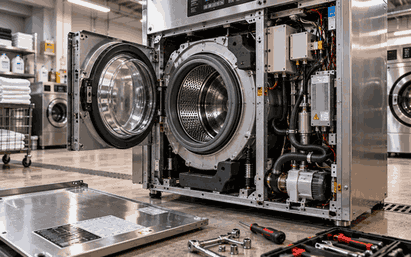
Reliable Hands Appliance diagnoses and repairs commercial washing machines used in laundromats, hotels, apartment and condominium laundry rooms, fitness centers, salons, assisted-living facilities, and managed commercial properties.
Service is available throughout Orange County, including Irvine, Costa Mesa, Newport Beach, Santa Ana, and Tustin.
Commercial washer repair addresses mechanical, electrical, hydraulic, and electronic faults that prevent equipment from filling, washing, draining, extracting water, or completing programmed cycles.
The stage at which a machine stops provides valuable diagnostic information. Facility operators should record the selected program, displayed fault message, and whether water remains in the drum.
Call (714) 338-9438 to request commercial washer repair. Same-day and emergency availability depends on technician coverage, equipment condition, business location, access restrictions, and replacement-part availability.
Commercial laundry equipment varies in capacity, mounting configuration, water requirements, payment technology, and operating controls.
Repair requests may involve:
Front-load commercial washers
Top-load commercial washers
Hardmount washer-extractors
Softmount washer-extractors
Coin-operated washing machines
Card-operated washing machines
On-premises laundry washers
Multi-housing laundry equipment
Stack washer-dryer combinations with washer-side malfunctions
For stacked equipment, identify whether the problem affects the washing section, drying section, or both.
Problems involving heat production, exhaust airflow, or dryer drum operation may require commercial dryer repair.
Provide the equipment's machine ID, model number, and serial number whenever possible.
For payment-enabled machines, describe whether the system accepts payment, activates the program, displays an error, or stops before the wash cycle begins.
A commercial washing machine may fail during a specific stage or become unable to start any wash program.
Determining exactly when the problem occurs helps narrow the systems requiring inspection.
Professional diagnosis may be necessary when a commercial washer:
Will not turn on or begin operation
Accepts payment without starting
Fills too slowly
Takes in too much water
Does not receive water
Fails to agitate or tumble
Stops in the middle of a wash cycle
Retains water after washing
Cannot spin or extract water effectively
Keeps the door locked after completion
Displays recurring error codes
Possible causes include defective water inlet valves, blocked supply screens, pressure sensors, drain pumps, door-lock assemblies, drive motors, belts, control boards, and wiring.
A failure to drain does not automatically mean the pump must be replaced. The drain path, associated controls, electrical connections, and external drainage conditions may also need evaluation.
Likewise, a failed extraction stage may involve load distribution, door locking, drainage, drive components, or control logic.
Professional testing helps identify the cause before replacement components are recommended.
Water leaks and unusual movement require prompt attention because they can affect both equipment reliability and property safety.
Leak sources may include:
Water inlet connections
Internal water hoses
Drain pumps
Drain assemblies
Door seals
Tub components
Detergent dispensing systems
Water can travel along the machine frame or beneath the cabinet. The visible location of a puddle may not correspond to the actual point of failure.
Excessive vibration, grinding, banging, or movement during extraction may involve uneven loading, incorrect leveling, mounting conditions, suspension components, bearings, or drive-system faults.
Stop operating a washing machine that leaks actively, moves away from its installed position, or produces severe mechanical noise.
Keep customers, residents, and employees away from the affected equipment. Close accessible water valves when it can be done safely.
Do not touch electrical connections while standing in water or when components may be wet.
Reliable Hands Appliance accepts repair requests for compatible Speed Queen commercial laundry equipment, including washers and washer-extractors.
Repair eligibility depends on the machine's model, control platform, payment configuration, technical documentation, and replacement-part availability.
When contacting the team, provide photographs of the manufacturer data plate and any displayed fault message.
For compatible Speed Queen equipment, the Speed Queen Commercial Appliance Error Codes guide provides additional information about control and operating alerts.
An error code is an indication of a detected condition, not proof that a particular component has failed.
Brand references identify equipment that may be evaluated for repair and do not imply manufacturer authorization or affiliation.
Commercial washing machines support operations in laundromats, hospitality properties, apartment communities, assisted-living facilities, gyms, spas, salons, healthcare environments, janitorial facilities, and workplace laundry rooms.
Equipment downtime may affect resident access, laundry capacity, employee workflows, and daily facility operations.
For properties operating several machines, identify each defective washer separately.
Provide information about:
Parking and loading access
Gates and entry systems
Lockboxes and keys
Service elevators
Utility rooms
Property-management procedures
Security restrictions
Permitted repair hours
A clear description of access requirements helps avoid delays when technicians arrive at commercial or managed properties.
Commercial washer repair involves documenting the malfunction, identifying the failed operating stage, and testing the systems associated with the reported symptoms.
Before requesting repair, gather the following details:
Business or property name
Complete service address
On-site contact
Machine identification number
Equipment brand
Model number
Serial number
Displayed error code
Failed cycle stage
Whether water remains inside the drum
Also mention recent plumbing work, electrical changes, payment-system problems, installation adjustments, or detergent changes that may be relevant.
These details help the technician understand whether the malfunction is related to the machine or an external operating condition.
During diagnosis, the technician may evaluate accessible components associated with:
Water supply and filling
Drainage
Mechanical operation
Electrical supply
Door-lock mechanisms
Drive and extraction systems
Electronic controls
A functional wash program may be used to observe the problem when operation is safe and unlikely to cause additional damage.
Testing helps distinguish a faulty machine component from a building drainage restriction, supply problem, payment-system malfunction, or other external issue.
After testing, the technician explains the findings, recommended corrective work, and any model-specific replacement-part requirements.
A failed component may be repaired or replaced when suitable parts and safe working conditions are available.
When the problem originates from a third-party payment platform, building plumbing system, or another external service, the findings can help the facility manager coordinate the appropriate next step.
Commercial washer maintenance consists of planned inspections and routine care intended to identify developing leaks, drainage restrictions, damaged hoses, worn door components, excessive vibration, and changes in cycle performance.
Facilities operating several machines can use the Commercial Appliance Preventive Maintenance Checklist to organize equipment inspections and monitor recurring maintenance concerns.
Depending on the machine and installation, maintenance may include:
Reviewing water filling performance
Checking drainage behavior
Inspecting accessible hoses
Evaluating visible water connections
Examining the door or lid system
Observing extraction and spin performance
Listening for bearing noise
Monitoring pump operation
Identifying abnormal drive-system sounds
Maintenance requirements depend on the washer's capacity, workload, design, installation conditions, and manufacturer instructions.
Staff should follow manufacturer recommendations for load sizes, detergent use, cleaning, and keeping appropriate drum and door areas dry between operating periods.
High-use facilities may benefit from documented inspections and planned maintenance across multiple machines.
For businesses operating several types of equipment, broader commercial appliance repair and maintenance support may help coordinate equipment care across the facility.
Preventive maintenance does not replace diagnosis of an active leak, failed drain cycle, recurring fault code, or severe vibration.
Commercial washer repair may be appropriate when the frame and tub remain structurally sound, the malfunction can be isolated, electronic controls and replacement parts remain available, and the machine has otherwise performed dependably.
Replacement may deserve consideration when:
Structural corrosion is extensive
Major component failures recur
Payment hardware is obsolete
Electronic controls are unsupported
Critical replacement parts are difficult to obtain
Frequent downtime disrupts laundry operations
For laundromats and shared laundry rooms, operational considerations also include the loss of available washing capacity and its effect on customers, residents, or employees.
The decision should account for equipment age, physical condition, repair history, component availability, workload, and the business consequences of repeated interruptions.
A professional diagnosis helps determine whether the existing washer can reasonably return to dependable operation.
Possible causes include blocked drainage, a malfunctioning drain pump, defective door locking, electronic controls, or a failure during another stage of the wash program.
Do not force the washer door open when water remains inside.
Record the displayed error message and request professional diagnosis.
Excessive vibration may result from uneven loading, incorrect leveling, mounting problems, damaged suspension components, worn bearings, or drive-system faults.
A washer that moves from its normal installed position should be taken out of service until the cause is identified.
Multiple machines can be discussed when arranging the repair appointment.
Provide a separate machine ID, model number, serial number, fault code, and symptom description for each affected washer.
This information helps the team assess the requested work and prepare for the visit.
Yes. Preventive maintenance can be arranged for supported commercial washers and dryers.
Maintenance requirements depend on equipment type, workload, operating conditions, installation, and manufacturer recommendations.
Contact Reliable Hands Appliance with the business or property address, machine ID, equipment brand, model and serial number, displayed error code, failed cycle stage, and site-access instructions.
Reliable Hands Appliance
Office: 410 Santa Maria, Irvine, CA 92606
Phone: +1 (714) 338-9438
Email: [email protected]
Hours: Monday-Friday, 7:00 AM-7:00 PM; Saturday, 9:00 AM-6:00 PM
Sunday: Emergency calls only; call to confirm availability
Time Zone: Pacific Time

