410 Santa Maria, Irvine, CA 92606
E-mail us: [email protected]
24 Hour Service - 7 Days a Week

Professional commercial dryer repair for no-heat conditions, poor airflow, long drying times, drum movement, ignition, controls, and safety shutdown problems.
Reliable Hands Appliance provides professional commercial dryer repair and preventive maintenance for laundromats, hotels, apartment and condominium laundry rooms, gyms, salons, assisted-living facilities, managed properties, and other commercial laundry operations.
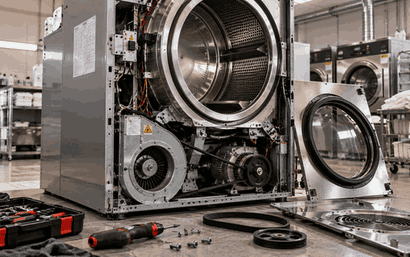
Reliable Hands Appliance provides professional commercial dryer repair and preventive maintenance for laundromats, hotels, apartment and condominium laundry rooms, gyms, salons, assisted-living facilities, managed properties, and other commercial laundry operations.
Reliable Hands Appliance provides commercial dryer diagnostics, repair, and preventive maintenance for businesses that depend on reliable laundry equipment every day.
Service is available throughout Orange County, including Irvine, Costa Mesa, Newport Beach, Santa Ana, and Tustin.
Commercial dryer failures can affect heating performance, exhaust airflow, drum rotation, ignition systems, cycle controls, and safety shutdown functions. Even when a dryer continues running, inadequate heat or restricted ventilation may lengthen cycles and reduce laundry throughput.
Call (714) 338-9438 to discuss gas or electric commercial dryer repair. Same-day and emergency appointments depend on location, technician availability, equipment condition, site access, and replacement-part requirements.
Commercial drying equipment differs in capacity, heating technology, exhaust configuration, electrical requirements, payment controls, and installation arrangements.
Repair requests may involve:
Commercial single dryers
Tumble dryers
Stack dryers
Coin-operated dryers
Card-operated dryers
On-premises laundry dryers
Multi-housing laundry equipment
Stack washer-dryer units with a dryer-side fault
Commercial dryers can operate with gas or electric heating systems, each with specific safety, electrical, and ventilation requirements.
Providing the complete model number, serial number, heating source, and machine identifier helps the service team assess equipment compatibility before the visit.
Reliable drying performance requires adequate heat production and consistent exhaust airflow. A failure in either system can affect cycle times, laundry condition, and equipment safety.
Professional diagnosis may be necessary when a commercial dryer:
Tumbles without producing heat
Takes longer than expected to dry comparable loads
Produces inconsistent heat
Stops before drying is complete
Overheats
Leaves laundry unusually hot
Displays airflow, temperature, or ignition errors
Ignites briefly before losing heat
Possible causes include heating elements, gas ignition components, thermostats, temperature sensors, limit devices, electrical controls, and airflow restrictions.
For additional diagnostic information, see the guide explaining why a commercial dryer runs but does not heat.
Heating components should not be replaced without considering airflow conditions. An unresolved exhaust restriction can cause repeated overheating or protective shutdowns.
Reliable Hands Appliance also diagnoses dryers that:
Will not start
Accept payment but do not begin a cycle
Fail to tumble
Produce squealing sounds
Make scraping noises
Thump during operation
Vibrate excessively
Stop during a cycle
Display recurring error codes
Problems may involve drive belts, drum rollers, bearings, motors, safety switches, wiring, electronic controls, or mechanical obstructions.
Stop operating equipment that produces smoke, sparks, a burning smell, a strong gas odor, severe overheating, or visible damage affecting laundry.
If gas is suspected, avoid electrical switches and ignition sources, leave the area, and follow the property's emergency procedures. Contact the gas utility from a safe location.
A commercial dryer's heating system and exhaust ventilation must function together to maintain effective drying performance.
Lint buildup, restricted ducts, damaged connections, blocked lint compartments, and obstructed exterior exhaust outlets can increase cycle times and operating temperatures.
Professional evaluation may involve the dryer and accessible exhaust connections, depending on the equipment and agreed repair scope.
Operators should follow manufacturer instructions for lint removal and never use a dryer with a missing or damaged lint screen.
Restrictions within shared building ducts may require a qualified ventilation specialist. Commercial appliance diagnosis can help identify when the problem extends beyond the dryer itself.
Commercial laundry repair requests may include Speed Queen gas and electric dryers.
Repair eligibility depends on the specific model, equipment configuration, technical documentation, and availability of compatible replacement parts.
Whenever possible, provide clear photographs of the manufacturer data plate, displayed error message, and machine identifier.
Brand references describe equipment that may be considered for service and do not indicate manufacturer authorization.
Professional commercial appliance repair supports laundromats, hotels, apartment communities, fitness centers, spas, salons, assisted-living facilities, janitorial operations, and workplace laundry rooms.
For facilities operating multiple dryers, identify each affected machine separately and describe the symptoms associated with each unit.
Useful site information includes:
Parking and loading access
Keys and gates
Security procedures
Utility-room locations
Restricted repair hours
Equipment access limitations
For stacked or closely installed equipment, describe clearance and accessibility restrictions before the technician arrives.
Commercial dryer repair involves reviewing equipment details, documenting the reported failure, assessing installation conditions, and testing systems associated with the symptoms.
Before the appointment, provide:
Site address
Site contact
Machine ID
Brand
Model number
Serial number
Gas or electric heat source
Error code
Exact symptom
Also explain whether the problem occurs during every cycle and whether other dryers connected to the same ventilation system show similar behavior.
The technician evaluates components relevant to the reported problem, potentially including:
Drive components
Heating system
Gas ignition system
Exhaust airflow
Temperature controls
Electrical components
Electronic controls
Testing involving gas and high-voltage equipment must be performed only under appropriate safety conditions.
Following diagnosis, the technician reviews the findings, recommended corrective work, and any model-specific replacement-part requirements.
When testing indicates a shared exhaust restriction, ventilation deficiency, or building utility problem, the facility contact can arrange the appropriate specialized service.
Commercial dryer maintenance involves regular inspection and appropriate cleaning to support airflow, detect component wear, and minimize unexpected equipment interruptions.
Depending on the model and installation, maintenance may involve checking:
Lint compartments
Accessible exhaust connections
Dryer drum
Door components
Belts
Support components
Temperature behavior
Gas ignition or electric heating operation
Visible wiring
Unusual sounds or vibration
Maintenance intervals should follow manufacturer guidance and reflect equipment usage.
Facilities operating high volumes of laundry should document routine lint care and investigate noticeable increases in drying times.
For broader operational guidance, review the commercial appliance preventive maintenance checklist.
Preventive maintenance cannot resolve an active gas leak, persistent overheating, a no-heat failure, or repeated safety shutdowns. These conditions require professional diagnosis and repair.
Commercial dryer repair may remain practical when the drum and cabinet are structurally sound, replacement parts are available, the malfunction can be isolated, and the equipment continues to meet operational requirements.
Replacement may warrant consideration when:
Heat damage is extensive
Structural wear is severe
Drive failures recur frequently
Control problems repeatedly interrupt operation
Essential replacement parts are unavailable
Persistent downtime disrupts business operations
The decision should also consider ventilation infrastructure and available utility supply.
Replacing a dryer will not resolve an exhaust or building-side utility problem that remains uncorrected.
Possible causes include failed electric heating components, gas ignition defects, temperature-control problems, activated safety devices, electronic control faults, or insufficient electrical or gas supply.
Testing appropriate to the model is required to determine the actual failure.
Longer drying times can result from restricted airflow, overloaded drums, inadequate heat, faulty moisture sensors, or drive-system problems.
Compare similar laundry loads and determine whether the change affects an individual dryer or several machines sharing the same exhaust system.
Yes. Commercial dryer repair requests are accepted for both gas and electric models.
Provide the heating source and complete model number when contacting the service team.
Yes. Providing an equipment list and site operating hours allows the team to evaluate arrangements for inspecting or maintaining several supported units during one visit.
Contact Reliable Hands Appliance with the property address, site contact, machine ID, brand, model number, serial number, heating source, displayed error code, symptoms, and access instructions.
Reliable Hands Appliance
Office: 410 Santa Maria, Irvine, CA 92606
Phone: +1 (714) 338-9438
Email: [email protected]
Hours: Monday-Friday, 7:00 AM-7:00 PM; Saturday, 9:00 AM-6:00 PM
Sunday: Emergency calls only; call to confirm availability
Time Zone: Pacific Time

