410 Santa Maria, Irvine, CA 92606
E-mail us: [email protected]
24 Hour Service - 7 Days a Week

Learn what Beverage-Air refrigeration error codes and alarms may indicate when commercial refrigerators, freezers, prep tables, or display equipment develop temperature and control problems.
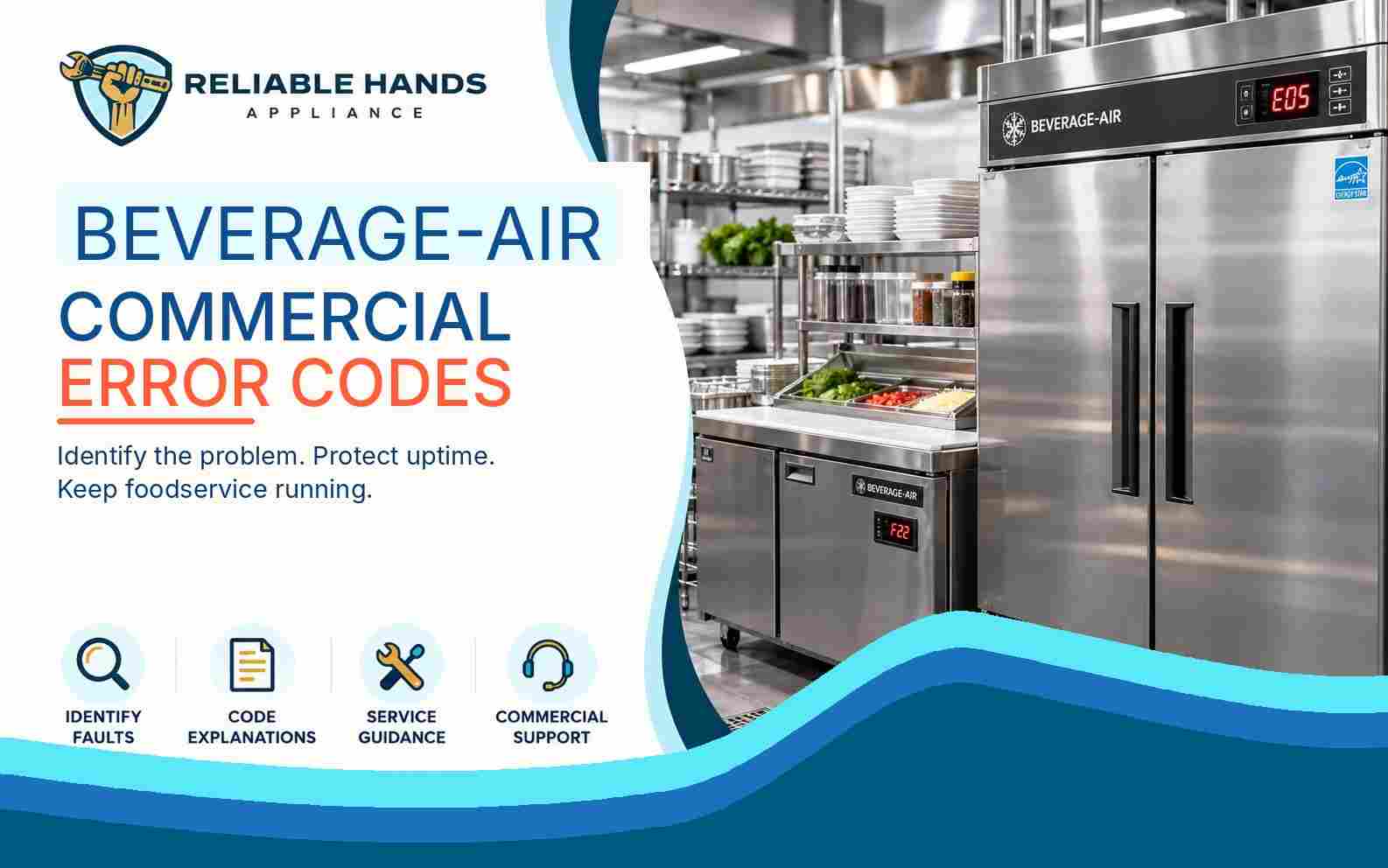
For restaurants, cafés, convenience stores, bars, and other food-service businesses, these warnings deserve prompt attention because refrigeration can continue running while cabinet or product conditions are already moving outside the intended range.
Beverage-Air commercial refrigeration equipment uses electronic controllers, temperature probes, compressor monitoring, door sensors, and alarm systems to maintain stable cabinet conditions.
When the controller detects an abnormal condition, the normal cabinet-temperature display may be replaced by an alarm code.
For restaurants, cafés, convenience stores, bars, and other food-service businesses, these warnings deserve prompt attention because refrigeration can continue running while cabinet or product conditions are already moving outside the intended range.
Beverage-Air has used multiple controller families, including Danfoss and Eliwell, so the exact code set depends on the equipment model and installed control.
Hi indicates that cabinet air temperature has remained above the configured high-temperature threshold.
Lo identifies a cabinet temperature below the low-temperature threshold.
High temperature may result from prolonged door openings, warm product loading, insufficient airflow, condenser trouble, sensor problems, or an actual refrigeration fault.
When the alarm remains active, verify actual product temperature rather than relying only on cabinet air readings.
Con is a condenser-temperature alarm.
Possible contributing conditions include a dirty condenser, restricted ventilation around the refrigeration system, or unusually high ambient temperature.
Because commercial refrigeration often operates around cooking equipment, condenser cleanliness and airflow can have a significant effect on performance.
dor means the door has remained open longer than permitted.
If the cabinet door is physically closed but the alarm remains, possible causes include door alignment, gasket condition, the door switch, or the controller input.
uHi identifies supply voltage above the controller's accepted range.
uLi or uLo indicates a low-voltage condition.
Persistent voltage alarms can affect compressor operation and should not automatically be interpreted as refrigeration-system failures.
Electrical supply conditions may need to be evaluated separately from the refrigerator or freezer itself.
LEA appears when the compressor operates continuously beyond the controller's configured time limit.
Although current documentation refers to it as a leakage alarm, the trigger is extended compressor runtime. The code alone does not prove that the refrigerant circuit is leaking.
Possible contributing causes include:
Dirty condenser surfaces
Prolonged door opening
Excessive product or ambient heat load
Sensor problems
Reduced refrigeration capacity
Low refrigerant charge
Other mechanical refrigeration faults
Professional measurements are required to determine the actual cause.
Danfoss-controlled Beverage-Air equipment can display E01, E02, E03, or E04 when one of the connected sensors becomes open, shorted, disconnected, or otherwise unavailable.
An invalid sensor reading can affect cabinet-temperature accuracy, compressor operation, and defrost control.
The exact function of sensors S1 through S4 varies by equipment configuration. Do not assume that the same E-code always represents the same physical probe on every Beverage-Air cabinet.
Other Beverage-Air equipment uses Eliwell controls with different alarm formats.
AH1 indicates that cabinet temperature is too warm.
OPd identifies an open-door condition.
E1, E2, E3, and E4 indicate disconnected or failed sensors on applicable models.
The display may also show dEF while the appliance is actively defrosting.
Importantly, dEF is a normal operating status rather than an equipment failure. Recognizing status messages prevents unnecessary shutdown of refrigeration that is operating correctly.
Two Beverage-Air units that look very similar can contain different electronic controllers and display different alarm formats.
The manufacturer supports separate product families including reach-ins, freezers, back bars, prep tables, bottle coolers, and MarketMax equipment.
Before interpreting an alarm:
Record the complete model number
Record the exact display message
Check current cabinet and product temperatures
Confirm that doors close completely
Inspect accessible condenser airflow
Note any recent loading or power events
A persistent high-temperature warning, repeated voltage fault, recurring sensor code, extended compressor-runtime alarm, or door warning that remains with the door closed should be diagnosed before parts are replaced.
Do not replace probes, electronic controls, compressors, or refrigeration components based only on the displayed code. Wiring, airflow, electrical supply, door operation, and refrigeration performance can create overlapping symptoms.
For professional Beverage-Air commercial refrigeration diagnostics and repair, contact Reliable Hands Appliance.
Phone: +1 (714) 338-9438
Email: [email protected]
Office Hours: Monday through Friday, 7:00 AM to 7:00 PM
Saturday: 9:00 AM to 6:00 PM
Sunday is reserved for emergency calls. Call to confirm availability.
Office: 410 Santa Maria, Irvine, CA 92606
Time Zone: Pacific Time

