410 Santa Maria, Irvine, CA 92606
E-mail us: [email protected]
24 Hour Service - 7 Days a Week

Explore Avantco commercial appliance error codes and control messages for refrigeration, ice machines, and cooking equipment, with possible causes and diagnostic considerations.
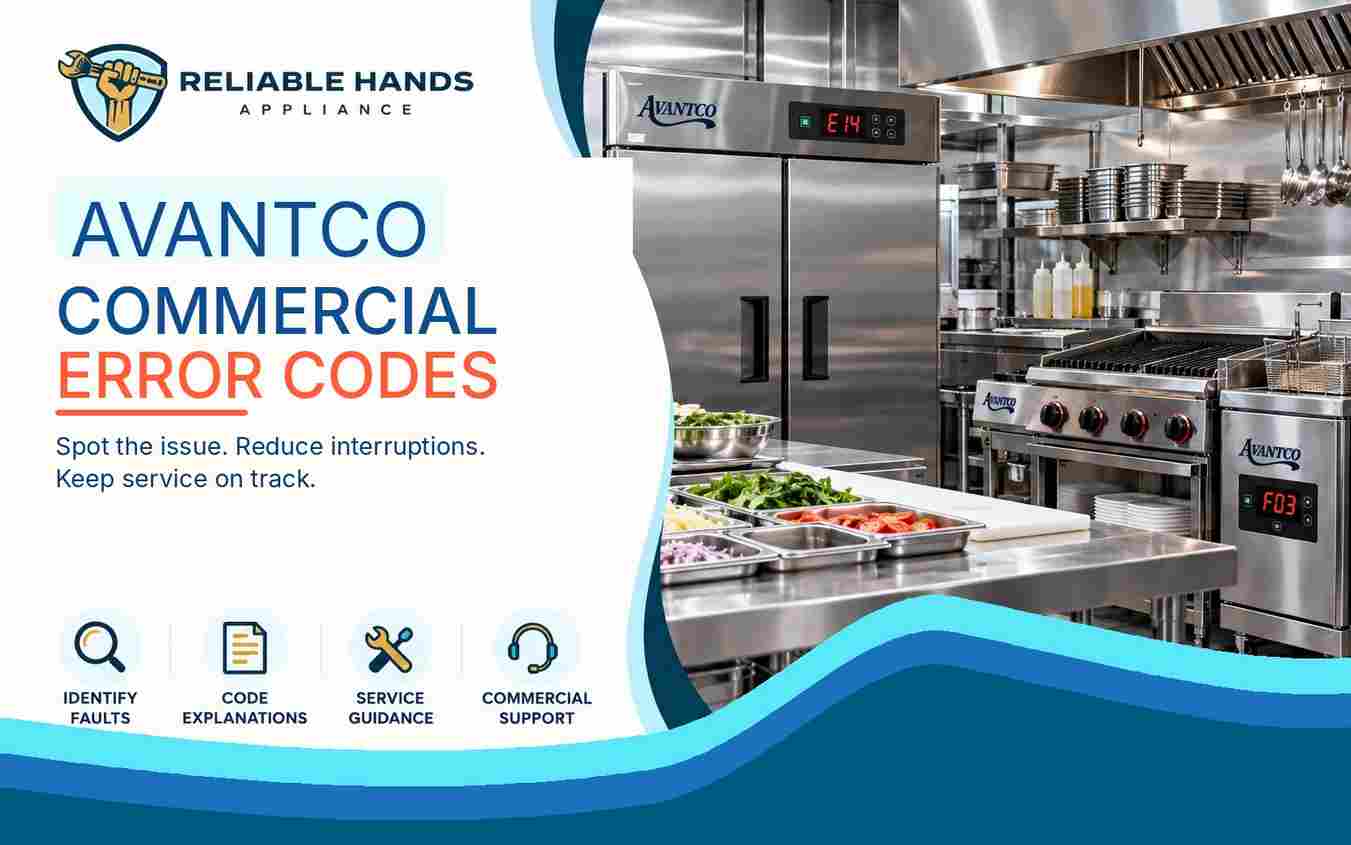
For restaurants, cafés, markets, bars, and other businesses, these warnings can affect more than appliance operation. Rising refrigeration temperatures may place inventory at risk, while an ice-machine shutdown can interrupt beverage and food-service workflows.
Avantco commercial refrigeration and ice equipment uses electronic controllers, temperature probes, water-level sensors, pressure protection, and other monitoring systems to identify abnormal operating conditions. When a fault occurs, the controller may display an alarm, interrupt refrigeration, or stop ice production to protect the equipment.
For restaurants, cafés, markets, bars, and other businesses, these warnings can affect more than appliance operation. Rising refrigeration temperatures may place inventory at risk, while an ice-machine shutdown can interrupt beverage and food-service workflows.
Avantco uses different controls across product families, so the exact model and complete error code should always be recorded before diagnosing the problem.
On applicable Avantco A Plus reach-in refrigeration:
HI means cabinet temperature has risen above the configured high-temperature limit.
LO means cabinet temperature has fallen below the low-temperature threshold.
These warnings can be caused by extended door openings, heavy product loading, blocked airflow, condenser problems, sensor faults, or an actual refrigeration-system failure.
When a temperature alarm remains active, check actual cabinet and product conditions rather than relying only on the display.
E1, E2, E3, and E5 identify broken, disconnected, or otherwise invalid temperature probes on supported units.
rE specifically identifies a control-probe problem.
A failed sensor can prevent the controller from reading cabinet conditions accurately and may interfere with compressor cycling or other temperature-management functions.
rSF indicates that the controller has detected a refrigeration-system failure condition.
The alarm can appear when cabinet temperature continues rising even though the compressor is operating. Possible contributing conditions include excessive heat load, an open door, frozen evaporator conditions, or a deeper mechanical refrigeration problem.
The code does not prove that the compressor or refrigerant circuit is the only possible cause.
CHt means condenser temperature has become too high.
A dirty condenser coil or excessive ambient temperature around the appliance can contribute. On supported models, refrigeration may stop temporarily to protect the system.
Commercial kitchens can load condensers quickly with grease, lint, and airborne debris, making airflow conditions especially important.
dor indicates that the door has remained open beyond the permitted period.
Frequent door use can raise cabinet temperature and extend compressor runtime, but a recurring warning should not automatically be blamed on staff. Gasket wear, hinge alignment, door position, or the related sensor may also require inspection.
Commercial freezer controls vary by series, but some Avantco models also use HI and LO temperature warnings.
Persistent high-temperature alarms are particularly important because frozen inventory can begin warming before the appliance completely stops operating.
Certain blast-chilling and freezing platforms use E01 for a communication problem between the main electronic board and control panel. An approved power restart may be used as an initial external check, but a returning fault requires further diagnosis.
Avantco modular ice machines use detailed E-codes for refrigeration, water supply, sensing, pressure protection, and pump operation.
E11 or E00 identifies a refrigeration-system fault on applicable machines.
This warning can appear when water flows over the evaporator but does not freeze correctly or when expected water circulation is not occurring.
E05 indicates a water-shortage condition.
E06 identifies a high-pressure fault.
Either condition can interrupt production and place the machine into protective shutdown.
E07 and E08 relate to condenser-temperature sensing.
E09 and E10 concern water or evaporator temperature circuits depending on the exact ice-machine generation.
Because sensor assignments differ between modular and nugget platforms, the model-specific documentation should be used.
E12 identifies a water-level control fault on supported modular machines.
E13 can involve the pump, water-level sensor, or drain-valve system.
These conditions may result in incomplete batches, failed harvest cycles, or complete production loss.
Record the complete error code, model number, cabinet temperature, product condition, and equipment behavior before clearing alarms.
Avoid repeatedly restarting refrigeration or ice equipment without identifying the cause. Do not replace probes, controls, pumps, compressors, or refrigeration components solely because of an online code description.
Persistent temperature, refrigeration, pressure, water-system, or electronic faults require professional testing.
For professional Avantco commercial appliance diagnostics and repair, contact Reliable Hands Appliance.
Phone: +1 (714) 338-9438
Email: [email protected]
Office Hours: Monday through Friday, 7:00 AM to 7:00 PM
Saturday: 9:00 AM to 6:00 PM
Sunday is reserved for emergency calls. Call to confirm availability.
Office: 410 Santa Maria, Irvine, CA 92606
Time Zone: Pacific Time

