410 Santa Maria, Irvine, CA 92606
E-mail us: [email protected]
24 Hour Service - 7 Days a Week

Professional thermostat diagnostics for inaccurate temperatures, blank displays, wiring and power issues, communication failures, cycling problems, and incorrect HVAC response.
Thermostat repair involves diagnosing and correcting control, sensing, wiring, power, setup, or communication problems that prevent an HVAC system from responding properly.
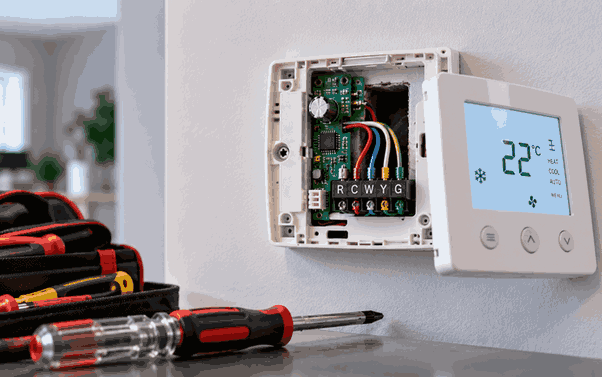
Thermostat repair involves diagnosing and correcting control, sensing, wiring, power, setup, or communication problems that prevent an HVAC system from responding properly.
Reliable Hands Appliance provides professional thermostat diagnostics and repair for homes, managed properties, offices, retail spaces, and other businesses throughout Orange County, including Irvine, Costa Mesa, Newport Beach, Santa Ana, and Tustin.
Thermostat repair involves diagnosing and correcting control, sensing, wiring, power, setup, or communication problems that prevent an HVAC system from responding properly.
A thermostat symptom does not always mean that the thermostat itself has failed. The actual problem may originate elsewhere in the heating or cooling system.
Call (714) 338-9438 to request thermostat repair and describe both the thermostat display and HVAC equipment behavior.
Thermostat problems can affect heating, cooling, fan operation, temperature control, and communication with HVAC equipment.
Professional diagnosis may be appropriate when:
The thermostat screen is blank or repeatedly loses power
Heating or cooling does not start after a command
The HVAC system continues running past the selected temperature
The displayed temperature appears inaccurate
The thermostat restarts or disconnects intermittently
Mode, fan, or programming controls do not respond
A smart thermostat will not communicate with the HVAC equipment
The system cycles too frequently
An error message or equipment alert repeatedly returns
Heating works but cooling does not, or the reverse
Before requesting repair, record the displayed message, selected mode, setpoint, room temperature, and whether the indoor or outdoor HVAC equipment responds.
A thermostat is part of a larger HVAC control system. Symptoms that appear to come from the thermostat may instead be caused by power, wiring, safety devices, equipment controls, or another HVAC component.
A blank thermostat display may involve batteries on applicable models, low-voltage power, a transformer, fuse, condensate safety switch, wiring, or the HVAC equipment itself.
Repeated power loss should be properly diagnosed instead of being treated only as a thermostat screen problem.
Drafts, direct sunlight, nearby heat sources, wall openings, or a sensing fault can affect thermostat readings.
A significant difference between the displayed thermostat temperature and actual room conditions may require both thermostat placement and operation to be evaluated.
Conventional, heat-pump, staged, zoned, and communicating HVAC systems can use different terminals and control logic.
A thermostat may physically fit the wall while still being electrically or functionally incompatible with the HVAC system.
The thermostat may send the correct command while a control board, safety device, blower, outdoor unit, heating component, or another part of the HVAC system fails to respond.
In these situations, AC repair, heating repair, or general HVAC repair may be the appropriate repair scope.
Thermostat repair may involve correcting an accessible connection, power issue, control problem, configuration fault, sensor issue, or another diagnosed failure.
Replacement may be considered when the thermostat is damaged, unreliable, obsolete, or incompatible with the functions required by the HVAC system.
A replacement thermostat should match:
HVAC equipment type
Heating and cooling stages
Heat-pump functions
Fan controls
Available wiring
Zoning configuration
Communication protocol
Wi-Fi connectivity and app features should remain secondary to proper HVAC compatibility.
Do not assume that every smart thermostat can replace every existing thermostat. Some proprietary or communicating HVAC systems require specific controls and setup.
Reliable Hands Appliance handles thermostat repair requests involving:
Standard digital thermostats
Programmable thermostats
Selected smart thermostats
Heat-pump controls
Thermostats serving qualifying commercial spaces
Zoned HVAC systems and building-control systems may contain additional components that fall outside the scope of standard thermostat repair.
For commercial properties, provide information about how many areas are affected, whether the thermostat is connected to a larger control network, equipment location, operating hours, access requirements, and property-management requirements.
A thermostat repair should identify whether the problem is actually inside the thermostat or originates elsewhere in the HVAC control system.
Provide the thermostat model when known, displayed message, selected mode, setpoint, HVAC equipment response, recent thermostat or electrical work, and when the problem first appeared.
The technician evaluates applicable power, wiring, settings, sensing, equipment calls, and HVAC response.
Testing helps distinguish an actual thermostat failure from a wider heating or cooling system problem.
Diagnostic findings are explained before thermostat repair or replacement proceeds.
If another HVAC component is responsible for the problem, the appropriate repair path can be identified.
After approved work, applicable heating, cooling, fan, and thermostat control functions are checked when system conditions permit.
Customer-owned Wi-Fi networks, accounts, or app-related issues may remain separate from the operation of the HVAC equipment itself.
Basic thermostat mode, setpoint, and battery checks may be reasonable when permitted by the manufacturer.
Turn off power before performing any permitted battery or faceplate procedure.
Do not connect thermostat wires based only on color, bridge terminals, or apply external power. Incorrect wiring can damage HVAC controls or create a safety hazard.
Stop troubleshooting and request qualified help when thermostat wiring is:
Burned
Wet
Loose inside the wall
Associated with repeated HVAC equipment shutdowns
Possible causes include batteries on applicable models, loss of low-voltage power, thermostat wiring, a fuse, condensate safety device, transformer problem, or HVAC equipment fault.
Professional testing can help determine whether the thermostat itself or another component is responsible.
Thermostat placement, surrounding airflow, wall conditions, calibration, sensing, or an internal thermostat fault may affect the displayed temperature.
Compare readings without opening or rewiring the thermostat.
Compatibility should first be confirmed based on the HVAC equipment, required functions, control wiring, and selected thermostat.
An assessment helps prevent installation of a thermostat that is incompatible with the existing system.
Yes. Shared power, wiring, sensing, or control problems may affect both heating and cooling modes.
However, equipment-specific HVAC faults may also cause only one mode to stop operating correctly.
Contact Reliable Hands Appliance with the property address, thermostat model, displayed message, equipment behavior, recent changes, and access details.
Reliable Hands Appliance
Office: 410 Santa Maria, Irvine, CA 92606
Phone: +1 (714) 338-9438
Email: [email protected]
Hours: Monday-Friday, 7:00 AM-7:00 PM; Saturday, 9:00 AM-6:00 PM
Sunday: Emergency calls only; call to confirm availability
Time Zone: Pacific Time

