410 Santa Maria, Irvine, CA 92606
E-mail us: [email protected]
24 Hour Service - 7 Days a Week

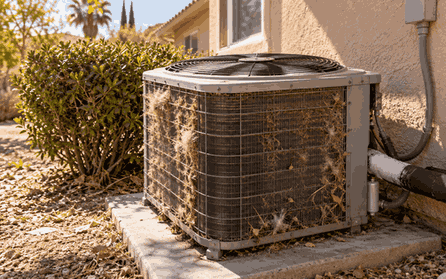
A high electric bill while the AC is running usually reflects longer cooling runtime, higher electricity rates, reduced system efficiency, or a combination of these factors.
A high electric bill while the air conditioner is running does not automatically mean the HVAC system has failed.
Higher consumption can result from long cooling cycles, extreme weather, clogged filters, dirty coils, thermostat settings, duct leakage, or declining equipment performance.
Changes in electricity rates, billing periods, and other household electrical loads can also affect the total bill.
Before assuming the compressor or another major component is defective, compare actual electricity consumption under similar conditions.
Review the current utility statement and compare its kilowatt-hour (kWh) consumption with an earlier period that had similar weather and occupancy.
Consider:
Total electricity use in kWh
Billing-period length
Changes in utility rates
Outdoor temperature and humidity
Household occupancy
Additional electrical equipment
AC operating hours
If the bill increased but consumption remained stable, changes in rates or billing conditions may explain the difference.
If electricity use increased significantly, the air conditioner and other major electrical loads deserve closer attention.
A higher bill alone does not identify which appliance or system is responsible.
A clogged air filter reduces airflow through the indoor cooling system.
This can weaken cooling, extend operating cycles, and contribute to evaporator icing.
Replace a visibly dirty filter with the correct manufacturer-approved type.
Keep supply vents and return grilles clear of furniture, curtains, and stored objects.
The evaporator absorbs heat indoors, while the condenser releases heat outdoors.
Accumulated dirt and debris can interfere with heat transfer, forcing the system to operate longer.
Inspect accessible outdoor ventilation areas for obvious restrictions. Internal coil cleaning may require professional maintenance.
An air conditioner normally operates with a closed refrigerant circuit.
A refrigerant leak or incorrect charge can reduce cooling capacity, contribute to icing, and extend runtime.
Adding refrigerant without identifying the underlying problem is not an appropriate repair.
Refrigerant testing and sealed-system work require qualified personnel.
An unnecessarily low setpoint, inaccurate temperature sensor, or incorrect program can increase operating time.
Poor thermostat placement near sunlight or heat-producing appliances can also affect temperature readings.
If the display is blank, temperatures appear inaccurate, or controls respond inconsistently, read Thermostat Not Working: Common Causes and Safe Checks.
Persistent control problems may require professional thermostat repair.
Damaged ducts can allow conditioned air to escape into attics, garages, or other unconditioned areas.
The system may run longer while occupied rooms remain uncomfortable.
Failing fan motors, capacitors, contactors, sensors, or electronic controls may also reduce performance.
When several connected components or airflow problems are involved, broader HVAC system diagnostics may be necessary.
Property owners can complete several basic inspections:
Compare kWh consumption with a similar previous period.
Confirm that the thermostat is set to Cool.
Review programmed temperatures and operating modes.
Replace a visibly dirty accessible filter.
Keep supply and return vents unobstructed.
Remove loose debris around the outdoor condenser without opening panels.
Record unusual noises, icing, water leakage, or continuous operation.
Do not open electrical compartments, add refrigerant, bypass protective controls, or repeatedly reset a tripping circuit breaker.
Stop using equipment that produces sparks, smoke, or electrical burning odors.
Modern air conditioners, heat pumps, and thermostats may display fault codes involving sensors, fan operation, electrical protection, or equipment communication.
These warnings can help direct diagnosis, but a fault code does not independently prove why electricity consumption increased.
Record the complete warning, equipment model, and operating symptoms.
Code meanings vary by manufacturer. Avoid replacing parts based only on a generic error description.
Professional evaluation becomes more important when higher electricity consumption appears alongside:
Continuous operation without adequate cooling
Weak airflow
Returning evaporator ice
Abnormal cycling
New mechanical noises
Repeated electrical faults
If the system circulates air but does not cool properly, review AC Not Cooling: Common Causes and Safe Checks.
Professional AC repair can identify problems involving airflow, coils, electrical components, thermostat controls, and refrigeration performance.
Professional AC maintenance can help identify dirty components, drainage restrictions, abnormal fan operation, and other conditions affecting performance.
Depending on the system, inspection may include airflow, filter condition, accessible coils, electrical controls, thermostat response, and operating measurements.
Maintenance supports proper operation but cannot guarantee a specific reduction in energy consumption.
Our guide How Often Should an HVAC System Be Serviced? explains preventive-care intervals.
Not necessarily.
An isolated repairable fault, incorrect setting, or airflow restriction may explain the problem.
However, repeated major failures and persistent efficiency problems may justify a broader equipment assessment.
The article Repair or Replace Your HVAC System explains factors to evaluate after diagnosis.
Usually not. A standard single-stage system generally cools at the same rate while operating. A lower setting may simply extend runtime.
Yes. Restricted airflow can reduce cooling performance and increase operating time, although other HVAC faults may produce similar symptoms.
Yes. Weather, utility rates, billing-period length, occupancy, and other electrical loads can increase the bill without an AC malfunction.
Comparing kWh consumption under similar conditions provides more useful information than comparing bill totals alone.
For professional AC performance diagnostics, efficiency-related troubleshooting, and repair, contact Reliable Hands Appliance.
Phone: +1 (714) 338-9438
Email: [email protected]
Office Hours: Monday through Friday, 7:00 AM to 7:00 PM
Saturday: 9:00 AM to 6:00 PM
Sunday is reserved for emergency calls. Call to confirm availability.
Office: 410 Santa Maria, Irvine, CA 92606
Time Zone: Pacific Time

