410 Santa Maria, Irvine, CA 92606
E-mail us: [email protected]
24 Hour Service - 7 Days a Week

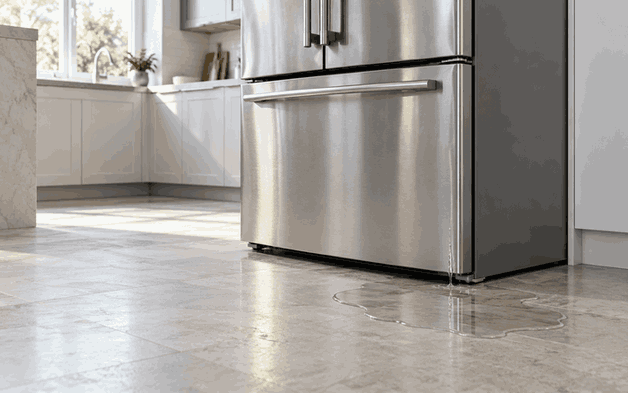
A refrigerator leaking water may have a blocked defrost drain, damaged water-supply line, loose connection, cracked filter housing, overflowing drain pan, frozen fill tube, condensation problem, or damaged door seal.
A refrigerator leaking water may have a blocked defrost drain, damaged water-supply line, incorrectly installed filter, faulty inlet valve, cracked drain pan, or deteriorated door gasket.
The location and timing of the leak offer useful clues. Water beneath freezer drawers may indicate a different problem from moisture behind the refrigerator or dripping from the dispenser.
If water approaches electrical connections, avoid touching wet components. Disconnect power only when safe and shut off the accessible refrigerator water supply if a pressurized leak continues.
Common leak locations include:
Under the refrigerator: A blocked defrost drain, damaged collection pan, or water connection may be responsible.
Behind the appliance: Check for accessible signs of moisture around supply tubing and connections.
Inside the fresh-food compartment: Possible causes include condensation, an obstructed drain, or a damaged filter housing.
Beneath freezer drawers: Repeated ice buildup may indicate frozen defrost drainage.
Near the dispenser: A filter, inlet valve, or internal water line may be involved.
Water can travel along panels and flooring, so the visible puddle does not always identify the original source.
During normal defrosting, water travels through a drainage passage to a collection pan beneath the appliance.
When ice, debris, or residue blocks the drain, water may accumulate inside the cabinet or freeze beneath drawers.
Do not puncture ice with sharp objects or remove internal freezer panels without proper qualifications.
If excessive frost also affects freezing performance, professional freezer repair may be appropriate.
Refrigerators with dispensers and ice makers use pressurized water connections.
A cracked tube, loose fitting, or defective inlet valve can cause intermittent or continuous leakage.
If water continues collecting behind the appliance, shut off its accessible supply valve when safe.
Do not disconnect pressurized fittings or move heavy built-in refrigerators to reach concealed connections.
A refrigerator that begins leaking after a filter replacement may have an incompatible cartridge, damaged seal, improperly seated filter, or cracked housing.
Use the filter specified for the exact model and follow manufacturer installation instructions.
Persistent leakage may require inspection of the filter housing and related tubing.
A frozen, damaged, or incorrectly positioned ice-maker fill tube may allow water to escape into the freezer compartment.
The problem can involve abnormal water delivery, inlet-valve operation, or ice-maker components.
Never apply uncontrolled heat to frozen internal tubing.
A cracked or displaced drain pan can allow defrost water onto the floor.
Meanwhile, worn door seals, misaligned hinges, or obstructed doors can introduce warm, humid air and cause excessive condensation.
Inspect accessible gaskets and confirm that the doors close completely.
Most refrigerators do not display a dedicated error for every water leak. However, certain warnings can help identify related systems.
Bosch: E02 may concern ice-maker operation on compatible models. See Bosch Appliance Error Codes and Bosch Appliance Repair in Orange County.
Miele: F121 indicates an ice-maker fault, while F383 concerns water inlet operation on supported models. Review Miele Error Codes.
Sub-Zero: Certain Classic models use 50 U 86 for slow water flow and 40 8 40 for excessive ice-maker filling time. See Sub-Zero Error Codes and Sub-Zero Repair.
LG: dH relates to defrost operation, while ER FF identifies a freezer-fan problem. Consult LG Error Codes.
Samsung: 21E may indicate a freezer-fan fault accompanying frost accumulation. See Samsung Error Codes.
These warnings do not independently confirm the source of a leak. Record the exact code and model number before resetting the appliance.
Identify when water appears: During defrosting, dispensing, ice production, or continuously.
Check whether the water filter is correctly installed.
Inspect visible tubing without disconnecting connections.
Confirm the doors close completely.
Look for ice beneath freezer drawers without removing fixed panels.
Record error codes and refrigerator temperatures.
Do not puncture ice, open electrical panels, or disconnect pressurized water lines.
Yes. Defrost problems may contribute to excessive frost, while damaged door seals can increase condensation and cooling demand.
If compartment temperatures are rising, read Why Is My Refrigerator Not Cooling?.
Protect temperature-sensitive food and monitor actual temperatures rather than assuming the cooling system remains normal.
Professional refrigerator repair is appropriate when leaks persist, water reaches electrical components, internal tubing is damaged, or frost repeatedly accumulates.
A technician can evaluate defrost drainage, water valves, filters, supply lines, door seals, ice-maker components, and related controls.
Provide the refrigerator brand, model number, leak location, and information about recent filter replacements or displayed errors.
A blocked defrost drain, condensation problem, filter housing, or internal water line may be responsible.
Yes. Defrost drains, damaged collection pans, and condensation problems can cause leaks even without an external water connection.
Defrost water may be unable to reach its collection pan because of an obstructed drain, damaged tube, or displaced pan.
For professional refrigerator leak diagnostics and repair, contact Reliable Hands Appliance.
Phone: +1 (714) 338-9438
Email: [email protected]
Office Hours: Monday through Friday, 7:00 AM to 7:00 PM
Saturday: 9:00 AM to 6:00 PM
Sunday is reserved for emergency calls. Call to confirm availability.
Office: 410 Santa Maria, Irvine, CA 92606
Time Zone: Pacific Time

