410 Santa Maria, Irvine, CA 92606
E-mail us: [email protected]
24 Hour Service - 7 Days a Week

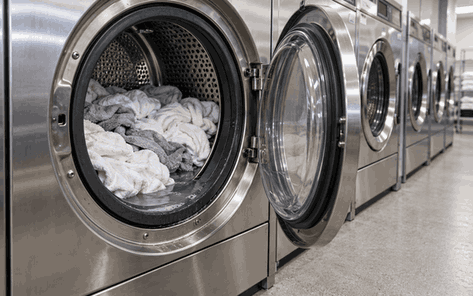
A commercial washer that is not draining may have an overloaded drum, blocked filter, kinked drain hose, facility drainage problem, failed pump, drain-valve fault, door interlock problem, payment-control issue, or electronic failure.
A commercial washer that is not draining may have a blocked filter, restricted hose, defective drain pump, faulty drain valve, door-lock problem, or electronic control failure.
For laundromats, hotels, and managed laundry facilities, retained water can interrupt operations and leave equipment unavailable.
If several machines develop drainage problems simultaneously, investigate the shared building drainage system before assuming that each washer has failed.
Observe whether the washer:
Stops with standing water inside
Drains slowly or intermittently
Makes pump noises without discharging water
Drains successfully but does not begin extraction
Displays an error or communication warning
Leaks beneath the machine
Record the failed cycle stage, equipment model, and any displayed code.
A washer that drains but will not spin requires different checks from a machine that cannot discharge water at all.
Lint, coins, fabric fragments, and other debris can accumulate in drainage components.
Some commercial washers provide operator-accessible filters, while others require technician access.
Clean only components identified for staff maintenance in the manufacturer's instructions.
Never open an unfamiliar drain assembly while the drum contains water. Sudden discharge can cause flooding and electrical hazards.
A kinked, crushed, or obstructed discharge hose may prevent normal water removal.
In multi-machine laundry rooms, shared drainage restrictions can affect several washers simultaneously.
Warning signs include water backing up near floor drains, slow drainage from multiple appliances, and standing water around discharge connections.
Building plumbing faults may require a qualified plumbing professional rather than appliance-component replacement.
Commercial machines use different drainage designs.
Some rely on a powered drain pump, while other washer-extractors use a controlled drain valve.
A damaged component may cause humming, grinding, intermittent drainage, or water remaining inside the drum.
However, a blocked drain path or electronic control problem can produce similar symptoms.
The pump, valve, wiring, and discharge connections should be tested before parts are replaced.
Heavy linens, towels, and unevenly distributed laundry can interfere with normal cycle progression.
A malfunctioning door interlock, lid switch, latch, or safety sensor may also interrupt operation.
Load imbalance usually affects extraction more directly than drainage, so these symptoms should be distinguished.
Do not force a locked door open while water remains inside.
Coin-operated and network-connected washers may use programmable controls, card readers, or payment modules.
A payment or communication fault may prevent a program from starting, while a controller fault may interrupt draining.
Record whether the machine accepts payment, starts washing, reaches the drain stage, and displays a warning.
These observations help separate mechanical drainage problems from controller faults.
Speed Queen commercial washers may use model-specific controller warnings for slow drainage or leaks. On certain platforms, a rightmost decimal-point indicator provides the warning.
The Speed Queen Commercial Error Codes Guide also explains communication and payment faults. For example, EC02 and EC18 concern communication, not direct drain-pump failure.
Facilities operating this equipment can review Speed Queen Commercial Laundry Repair in Orange County.
Some managed properties use household-style washers rather than industrial machines. On compatible models:
LG OE: Drainage fault — LG Error Codes.
Samsung 5C/5E: Water not draining normally — Samsung Error Codes.
Whirlpool F9 E1: Long-drain condition — Whirlpool Error Codes.
Miele F11: Drainage fault — Miele Error Codes.
These residential codes are not universal codes for industrial washer-extractors. Always confirm the model and controller generation.
Trained staff may perform approved external checks:
Stop the cycle safely and follow the manufacturer-approved retained-water procedure.
Check whether the load is excessive or uneven.
Inspect visible discharge hoses for restrictions.
Clean only operator-accessible filters.
Observe whether nearby washers and floor drains function normally.
Record warning codes, leaks, and abnormal noises.
Do not reach into moving drums, bypass interlocks, remove energized panels, or tip a water-filled washer.
Keep customers away from leaking equipment and electrical hazards.
Professional commercial washer repair is appropriate when drainage remains incomplete, pumps or valves produce abnormal noises, water leaks, or fault codes repeatedly return.
A technician can evaluate drainage components, electronic controls, interlocks, and equipment connections.
Provide the machine capacity, model and serial numbers, operating symptoms, and details about shared drainage problems.
For preventive inspections and equipment records, review the Commercial Appliance Preventive Maintenance Checklist.
Possible causes include load imbalance, worn drive components, sensors, suspension, or door-lock faults. The related Washer Not Spinning Guide explains general principles.
Yes. Excessive suds can interfere with water-level sensing and normal cycle progression. Follow the equipment manufacturer's detergent requirements.
Some symptoms overlap, but industrial washers may use different pumps, valves, and controls. Our Residential Washer Not Draining Guide applies to household-style equipment.
For professional commercial washing machine drainage diagnostics and repair, contact Reliable Hands Appliance.
Phone: +1 (714) 338-9438
Email: [email protected]
Office Hours: Monday through Friday, 7:00 AM to 7:00 PM
Saturday: 9:00 AM to 6:00 PM
Sunday is reserved for emergency calls. Call to confirm availability.
Office: 410 Santa Maria, Irvine, CA 92606
Time Zone: Pacific Time

