410 Santa Maria, Irvine, CA 92606
E-mail us: [email protected]
7 Days a Week

A Whirlpool washer displaying F5 E3 may refuse to lock its door or release trapped laundry. Discover how obstructions, damaged latches, and control problems affect the locking system, with safe checks and model-specific reset guidance.
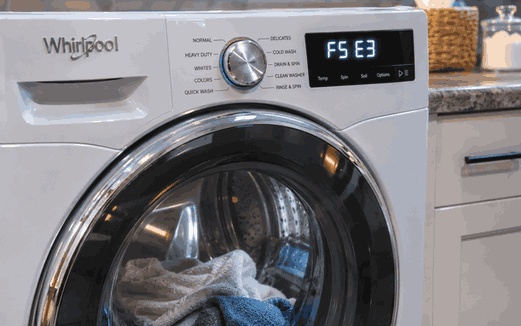
A Whirlpool washer F5 E3 error code indicates a problem involving the washing machine's door or lid locking system
A Whirlpool washer F5 E3 error code indicates a problem involving the washing machine's door or lid locking system. Depending on the model, the washer may be unable to lock or unlock correctly, preventing a wash cycle from starting or leaving laundry trapped inside.
The warning does not automatically mean the door latch needs replacement. Before attempting a reset, check for visible obstructions, identify how the door behaves, and follow Whirlpool's instructions for your specific model.
Never force the washer door open or bypass its locking mechanism.
The F5 E3 or F5E3 warning identifies abnormal door-lock operation on supported Whirlpool washing machines.
On certain front-load models, the error indicates that the door cannot lock properly. Other Whirlpool appliance families may display F5E3 when the locking system cannot release the door.
Front-load and top-load washers also use different locking mechanisms, making the complete model number essential for accurate troubleshooting.
The code identifies a problem involving the locking system rather than confirming that a particular component has failed.
For additional manufacturer-specific warnings, explore our Whirlpool appliance error code guide.
Several mechanical and electrical conditions can interfere with the Whirlpool washer door-lock system.
A sock, towel, or another laundry item trapped between the door and cabinet can prevent complete closure.
Even a small obstruction may stop the locking mechanism from engaging correctly.
Check the visible door opening and remove accessible clothing before assuming an internal component is defective.
A damaged door latch, door strike, or locking assembly may prevent normal operation.
Repeatedly slamming the door or forcing the handle can worsen mechanical damage.
A technician should verify alignment and component operation before recommending replacement.
The washing machine's electronic control monitors whether the door or lid is safely locked.
Damaged wiring, an interrupted connection, or an abnormal lock-state signal may prevent the wash cycle from starting or completing.
These problems can produce symptoms similar to a defective mechanical latch.
Electrical and control-system faults require professional testing, not homeowner disassembly.
The correct response depends on whether the washer refuses to lock, remains locked, or displays the warning during a specific stage of operation.
Stop the washing program and inspect the accessible door opening.
Remove trapped laundry or packaging without using tools.
Check visible latch surfaces for detergent residue, dirt, or obvious damage.
Close the door normally without forcing it into position.
If the Whirlpool washer still refuses to lock, further diagnosis may be necessary.
A locked washing machine does not automatically have a defective latch.
Front-load washers may keep the door locked while:
Water remains inside the drum.
The water temperature is elevated.
The drum is still rotating.
The appliance is completing a protective operating sequence.
Wait until the washing machine stops completely and follow the manufacturer's instructions.
Some washing machines retain the door lock while water remains inside the drum.
If the washer has not drained properly, the locking system may prevent opening until safe conditions are established.
Our guide explaining why a washing machine is not draining covers common drainage restrictions, pump problems, and interrupted cycles.
Never insert tools around the door latch, pull aggressively on the handle, or attempt to bypass a safety interlock.
If standing water remains, follow your Whirlpool model's approved draining instructions before considering any permitted emergency-release procedure.
An unfamiliar emergency-release mechanism should be inspected by a qualified technician.
If F5 E3 appeared after delivery or appliance movement, record that timing.
Inspect accessible areas for door misalignment, trapped packaging, or visible shipping damage.
Do not remove mounting hardware or attempt to reposition a heavy or stacked laundry appliance without appropriate assistance.
For applicable Whirlpool front-load models, the manufacturer recommends disconnecting electrical power for approximately five minutes to reset the washing machine's control system.
Always use the procedure specified for your exact appliance.
Stop the washer using its normal controls.
Disconnect electrical power safely.
Wait approximately five minutes.
Reconnect power.
Check whether the error remains and whether the door operates normally.
Avoid reaching behind heavy appliances or moving a stacked dryer to access an unsafe electrical connection.
A reset may clear a temporary control interruption, but it cannot remove trapped clothing, repair a damaged latch, or correct defective wiring.
If F5 E3 repeatedly returns, discontinue further resets and request professional diagnosis.
Although Whirlpool washing machines may display similar error-code formats, their locking mechanisms and operating procedures differ.
Front-load washers use a door-lock mechanism designed to prevent opening during unsafe operating conditions.
Depending on the model, F5 E3 may appear when the door cannot lock properly or the appliance detects an abnormal locking condition.
Problems involving retained water, door alignment, and lock-state detection may require different checks.
Top-load washers use a lid-lock system with different mechanical and electrical components.
Certain Whirlpool washer families associate F5-series warnings with lid-lock operation.
However, the precise interpretation depends on the model and should not be assumed from the code alone.
Do not apply front-load emergency-release procedures to a top-load washing machine.
Always identify the complete model number and actual locking behavior before troubleshooting.
Professional inspection is appropriate when accessible obstructions have been excluded and the washer still cannot lock or unlock normally.
Depending on the appliance design, a technician may evaluate:
Door latch or lid-lock assembly operation.
Door strike alignment and mechanical damage.
Lock-state detection and related sensors.
Electrical wiring and connections affecting the locking system.
Electronic control components responsible for door-lock operation.
These are potential diagnostic areas, not confirmed component failures.
If the washer leaks, repeatedly trips a circuit breaker, or produces a burning smell, discontinue use immediately.
Reliable Hands Appliance provides professional washing machine repair for door-lock faults, drainage problems, interrupted wash cycles, and electronic failures.
No. Trapped clothing, door alignment problems, locking conditions, wiring faults, or electronic control issues may contribute to the warning.
The exact cause should be identified before replacing the latch.
Not necessarily. Disconnecting power does not guarantee that a locked door will open immediately, particularly when water remains inside the washing machine.
Follow the manufacturer's model-specific instructions.
No. Bypassing the door-lock mechanism removes an important safety function and may create additional hazards.
If the door remains locked, request qualified assistance rather than attempting to defeat the interlock.
Yes. On supported models, the washer may refuse to begin a cycle when it cannot verify that the door is securely locked.
A visible obstruction or mechanical alignment problem may be responsible, but recurring errors can require electrical diagnosis.
Reliable Hands Appliance provides residential washing machine diagnostics and repair throughout Irvine, Costa Mesa, Newport Beach, Santa Ana, Tustin, and surrounding Orange County communities.
Our technicians address washer door-lock failures, lid-lock problems, electronic control faults, drainage issues, and interrupted washing cycles.
For homeowners in Newport Beach, explore our local washing machine repair services, including assistance with washers that will not start, remain locked, or display recurring error codes.
When requesting service, provide your Whirlpool model number, complete F5 E3 warning, door-lock behavior, and details about any trapped laundry or recent installation work.
This information helps identify the relevant locking system and determine which components require inspection.
If your Whirlpool washing machine continues displaying F5 E3, cannot lock its door, or leaves laundry trapped inside, contact Reliable Hands Appliance to request professional diagnosis and repair.
Business Name: Reliable Hands Appliance
Phone: +1 (714) 338-9438
Email: [email protected]
Address: 410 Santa Maria, Irvine, CA 92606, United States
Hours: Monday – Saturday: 8:00 AM – 7:00 PM; Sunday: Closed