410 Santa Maria, Irvine, CA 92606
E-mail us: [email protected]
7 Days a Week

A Frigidaire refrigerator HI or H1 warning means the fridge or freezer is too warm. Learn why power outages, open doors, and cooling problems trigger the alert, how to protect stored food, and when professional repair is needed.
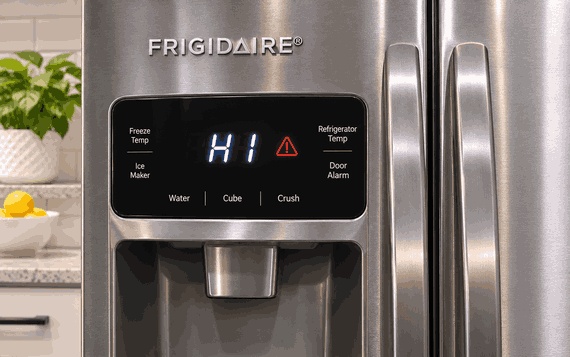
A Frigidaire refrigerator H1 or HI error code indicates that the refrigerator or freezer has become warmer than its permitted temperature range. The warning may appear after a power outage, prolonged door opening, or a cooling problem.
A Frigidaire refrigerator H1 or HI error code indicates that the refrigerator or freezer has become warmer than its permitted temperature range. The warning may appear after a power outage, prolonged door opening, or a cooling problem.
On some displays, the letter I resembles the number 1, causing confusion between HI and H1.
The warning does not automatically mean the compressor or temperature sensor is defective. Before clearing the alert, check actual compartment temperatures and protect perishable food.
The H, HI, or High Temp warning indicates an elevated temperature inside the refrigerator or freezer compartment.
Frigidaire uses this alert when monitored cooling conditions exceed the appliance's temperature limits.
The warning identifies a temperature problem rather than a specific component failure.
Importantly, the temperature that activates an alarm is not necessarily the temperature considered safe for storing perishable food.
A refrigerator can become too warm for safe food storage before or without a visible warning, depending on the model.
A prolonged power interruption can allow refrigerator and freezer temperatures to rise.
When electricity returns, the refrigerator may resume cooling while the High Temp warning remains active.
Frigidaire distinguishes two notifications:
PF (Power Failure): Indicates an interruption in electrical power.
HI (High Temperature): Indicates that a refrigerator or freezer compartment became excessively warm.
Acknowledging a PF warning does not immediately restore safe food-storage temperatures.
Record when the power failed, when it returned, and whether the refrigerator doors remained closed.
These details can help determine whether the appliance is recovering from the outage or experiencing a separate cooling problem.
Several operating conditions and cooling-system problems can trigger the warning.
Leaving a refrigerator door open for an extended period allows warm air to enter.
The cooling system may struggle to maintain normal temperatures, especially when the kitchen is warm.
Check whether food packages, drawers, or storage containers prevent the door from closing completely.
A damaged refrigerator door gasket can allow warm, humid air into the compartment.
Inspect accessible sealing surfaces for dirt, damage, or visible gaps.
Clean accessible residue according to the manufacturer's instructions.
Do not force door alignment or remove mounting hardware without appropriate guidance.
Frigidaire recommends approximately 37°F for the refrigerator and 0°F for the freezer in typical kitchen installations.
Check whether someone recently changed these settings.
Avoid repeatedly selecting colder temperatures to compensate for an unresolved cooling problem.
If temperatures remain elevated despite correct settings and closed doors, the appliance may have a more serious cooling issue.
Possible diagnostic areas include evaporator fans, blocked airflow, defrost components, temperature sensors, electronic controls, or the refrigeration system.
The HI warning alone cannot identify which component is responsible.
Our refrigerator not cooling troubleshooting guide explains other common causes of temperature loss.
Prioritize food safety before attempting to reset the refrigerator.
Use an appliance thermometer rather than relying only on the control-panel display.
Recommended temperatures are 40°F (4°C) or below for refrigerated food and approximately 0°F (-18°C) for frozen food.
A selected control-panel temperature does not prove that the compartment has reached that temperature.
According to FoodSafety.gov, an unopened refrigerator generally keeps food cold for approximately four hours during a power outage.
Perishable foods held above 40°F for two hours or longer should be discarded.
Food can become unsafe without developing an unusual smell or visible change.
Never taste food to determine whether it is safe.
Transfer vulnerable products to another working refrigerator or appropriately cooled container when necessary.
For extended outages, follow official food-safety guidance for refrigerated and frozen products.
Confirm that both refrigerator and freezer doors close completely.
Remove packages blocking the door openings and inspect accessible gasket surfaces.
Verify the selected temperature settings without changing unrelated control options.
Keep door openings brief while the refrigerator recovers.
Record thermometer readings at reasonable intervals and note whether temperatures are improving.
Recovery time depends on the outage duration, refrigerator design, food quantity, room conditions, and whether the cooling system is functioning normally.
If temperatures remain elevated, do not assume the problem will resolve without repair.
On compatible models, pressing the Clear Alerts button acknowledges the high-temperature warning.
Frigidaire notes that certain displays show the highest recorded temperature when the alert is first acknowledged.
Photograph this reading if it is available.
Some models also permit a brief electrical reset. Follow the procedure in your refrigerator's owner's manual.
Clearing the HI warning does not guarantee that normal cooling has returned.
Continue monitoring actual temperatures and investigate any recurring warning.
Professional inspection is appropriate when the HI warning returns without an obvious power outage, compartment temperatures remain elevated, or cooling continues to deteriorate.
A technician may evaluate airflow, temperature sensing, defrost operation, electrical controls, and refrigeration components.
The compressor should not be replaced solely because the refrigerator displays HI.
Our residential refrigerator repair service addresses cooling failures, unstable temperatures, and related electronic problems.
If the problem primarily affects the freezer compartment, explore our freezer repair services.
Often, yes. On certain displays, the capital letter I resembles the number 1.
Confirm the exact warning using your refrigerator's model number and owner's manual.
No. HI reports an elevated temperature.
Problems involving airflow, door seals, sensors, defrost operation, or other cooling components can produce the same warning.
Yes. If the alert followed a temporary power interruption or an open door, it may clear after normal cooling returns.
Persistent or recurring warnings require further investigation.
Check actual temperatures and protect perishable food first.
On supported models, you can acknowledge the warning using the manufacturer's instructions. However, clearing the display does not correct an ongoing cooling problem.
Reliable Hands Appliance provides residential refrigerator diagnostics and repair throughout Irvine, Costa Mesa, Newport Beach, Santa Ana, Tustin, and surrounding Orange County communities.
Our technicians evaluate temperature-control problems, cooling failures, airflow restrictions, defrost systems, and electronic faults.
For homeowners in Newport Beach, additional local service information is available through our refrigerator repair in Newport Beach page.
When requesting assistance, provide your Frigidaire model number, displayed HI or H1 warning, actual temperature readings, and any recent power-outage history.
If your Frigidaire refrigerator continues displaying HI, cannot maintain safe food-storage temperatures, or develops recurring cooling problems, contact Reliable Hands Appliance to request professional diagnosis and repair.
Business Name: Reliable Hands Appliance
Phone: +1 (714) 338-9438
Email: [email protected]
Address: 410 Santa Maria, Irvine, CA 92606, United States
Hours: Monday – Saturday: 8:00 AM – 7:00 PM; Sunday: Closed
Time Zone: Pacific Time