410 Santa Maria, Irvine, CA 92606
E-mail us: [email protected]
24 Hour Service - 7 Days a Week

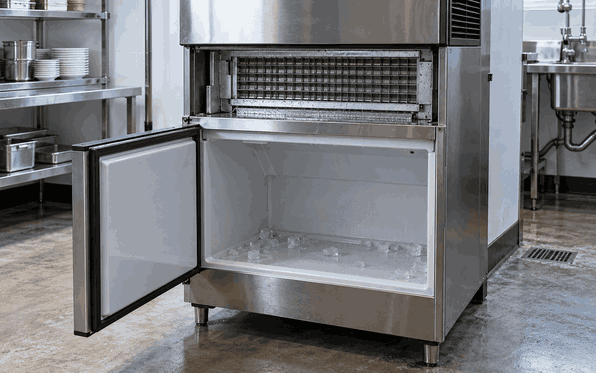
A commercial ice machine that is not making ice may have restricted water flow, poor ventilation, dirty condenser surfaces, scale buildup, a clogged water filter, drainage problems, failed sensors, harvest faults, valve problems, or a refrigeration-system failure.
A commercial ice machine that is not making ice may have restricted water flow, a clogged filter, dirty condenser coils, mineral buildup, drainage problems, faulty sensors, or a refrigeration-system malfunction.
For restaurants, hotels, cafés, and bars, reduced ice production can quickly interrupt daily operations.
Before assuming the compressor has failed, identify whether the machine cannot fill, freeze, release ice, or complete its operating cycle. Each symptom points toward a different group of possible causes.
Commercial ice machines complete several operating stages: water filling, freezing, harvesting, and bin storage.
Common symptoms include:
No water entering the machine
Water circulating without freezing
Small, hollow, or incomplete ice cubes
Ice forming but not releasing
Production stopping before the bin is full
Unusually long cycles or repeated shutdowns
Record when the problem occurs and whether an error code appears.
Also confirm whether the equipment is air-cooled, water-cooled, or connected to a remote condenser.
A closed supply valve, insufficient water pressure, clogged filter, or obstructed inlet can prevent the machine from receiving enough water.
Small or hollow ice cubes may indicate an incomplete fill cycle.
Check accessible supply connections and filter indicators according to manufacturer instructions.
Air-cooled ice machines need adequate ventilation to release heat.
Grease, dust, lint, and blocked condenser grilles can reduce cooling performance, especially in hot commercial kitchens.
Keep ventilation openings unobstructed and follow manufacturer-approved condenser maintenance procedures.
Hard-water minerals can accumulate inside water-distribution channels, sensors, and other wetted components.
Excessive scale buildup may interfere with freezing, water circulation, and ice harvesting.
Cleaning and descaling must follow the manufacturer's approved procedures.
Never mix cleaning and sanitizing chemicals or use products not approved for the equipment.
A clogged or incorrectly routed drain can interrupt operation or cause water to collect around the machine.
If nearby floor drains also back up, the building's drainage system may require inspection.
Persistent leakage should be investigated before normal operation resumes.
Commercial ice machines use bin controls, water-level sensors, inlet valves, and electronic controllers to manage production.
A malfunctioning bin sensor may incorrectly indicate that the storage bin is full.
A defective valve or control component may prevent filling or interrupt the operating sequence.
When water circulates normally but does not freeze, the problem may involve refrigeration performance, temperature sensing, or electrical controls.
If ice forms but remains attached to the evaporator, the harvest mechanism or associated controls may require diagnosis.
Refrigerant handling and internal electrical testing must be performed by qualified personnel.
Certain commercial ice machines display diagnostic codes or beep patterns when production is interrupted.
On compatible Hoshizaki IM-Series equipment:
E1: Freeze-cycle error
E2: Harvest-cycle error
EE (E8): Pump-motor lock
Some Hoshizaki KM modular cubers instead use repeating beep patterns. Two beeps can indicate a harvest timeout, while three beeps may indicate an excessively long freeze cycle.
Review the Hoshizaki Commercial Error Codes Guide for model-specific explanations.
On applicable Avantco modular ice machines:
E05: Water shortage
E11 / E00: Refrigeration-related fault
E12: Water-level control fault
E13: Pump, water-level sensor, or drain-valve problem
The Avantco Commercial Error Codes Guide explains these warnings in greater detail.
Record the complete error code and model number before resetting the machine. Codes identify detected conditions, not guaranteed failed components.
Before requesting professional repair, trained employees can perform approved external checks:
Confirm power and water supply.
Verify the machine's normal operating settings.
Check whether the storage bin is actually full.
Inspect accessible filters and ventilation openings.
Look for visible leaks or drainage backups.
Record unusual noises, displayed errors, and production changes.
Do not bypass safety devices, remove internal refrigeration panels, force ice off the evaporator, or repeatedly restart equipment displaying protective alarms.
If the machine has a sanitation problem or ice may be contaminated, stop serving the affected ice. Follow the establishment's approved disposal, cleaning, and sanitizing procedures.
Professional commercial ice machine repair is appropriate when approved cleaning and external checks do not restore normal production.
Reliable Hands Appliance works with supported commercial equipment, including Hoshizaki ice machines and Avantco ice machines.
Request diagnosis when the machine repeatedly stops, fails to freeze or harvest ice, leaks, produces abnormal noises, or displays recurring error codes.
Provide the brand, model, serial number, ice type, cooling configuration, approximate production level, and observed malfunction.
Possible causes include restricted water supply, a clogged filter, mineral deposits, or abnormal freeze-cycle operation.
Yes. High ambient temperatures, warm incoming water, and inadequate ventilation can reduce output, particularly in air-cooled machines.
Manufacturer-approved cleaning and sanitizing can reduce scale and contamination risks, but maintenance cannot prevent every mechanical failure.
The Commercial Appliance Preventive Maintenance Checklist provides additional guidance for commercial equipment care.
For professional commercial ice machine diagnostics and repair, contact Reliable Hands Appliance.
Phone: +1 (714) 338-9438
Email: [email protected]
Office Hours: Monday through Friday, 7:00 AM to 7:00 PM
Saturday: 9:00 AM to 6:00 PM
Sunday is reserved for emergency calls. Call to confirm availability.
Office: 410 Santa Maria, Irvine, CA 92606
Time Zone: Pacific Time

