410 Santa Maria, Irvine, CA 92606
E-mail us: [email protected]
24 Hour Service - 7 Days a Week

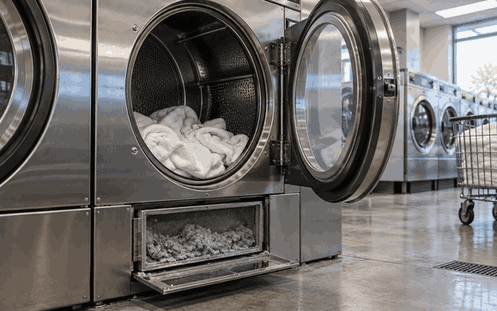
A commercial dryer that runs but does not heat may have restricted exhaust airflow, incorrect cycle settings, incomplete electrical supply, failed heating components, gas ignition trouble, thermal protection activation, airflow-switch failure, sensor problems, or an electronic control fault.
A commercial dryer that runs but does not heat may have restricted exhaust airflow, incorrect cycle settings, incomplete electrical supply, failed heating components, gas ignition trouble, thermal protection activation, airflow-switch failure, sensor problems, or an electronic control fault.
In a laundromat, hotel, apartment community, or managed laundry room, a no-heat condition can quickly reduce throughput and increase cycle times. Repeatedly running the dryer is not an appropriate workaround when the machine is not heating or exhausting properly.
Stop use if there is a burning odor, smoke, scorching, excessive cabinet heat, strong gas odor, or poor exhaust airflow.
Heat and airflow operate together.
A heavily loaded lint screen, restricted exhaust duct, or blocked exterior termination can:
Extend drying time
Increase equipment temperature
Activate protective devices
Reduce available drying capacity
Contribute to fire risk
High-use commercial laundry rooms can accumulate lint quickly, and a shared exhaust restriction may affect more than one dryer.
If several machines suddenly show weak airflow or extended dry times, the common exhaust system should be considered.
Clean operator-accessible lint screens at the required interval and inspect approved airflow points.
Do not operate commercial dryers with disconnected ducting as a test.
Air-only settings, programming issues, or a cycle that did not authorize correctly can look like a heating failure.
Confirm the selected cycle and displayed status before assuming an internal part has failed.
Some electric commercial dryers can continue tumbling even when the heater does not receive the complete electrical supply it requires.
A repeatedly tripping breaker should not be continuously reset.
Igniters, gas valves, flame sensors, and proving controls may prevent burner operation.
Persistent or strong gas odor is not normal. Stop operation and follow the facility's emergency and utility procedures.
A failed element, fuse, or high-limit device can interrupt heat.
The reason the protective component opened should also be investigated, particularly when airflow has been restricted.
Sensors, switches, relays, and electronic boards can prevent heating or cause cycles to end before laundry is dry.
Professional electrical testing may be required to distinguish these faults.
Operators can:
Confirm the cycle and displayed status.
Clean the accessible lint screen.
Observe airflow at an approved accessible point.
Compare performance with nearby dryers.
Record alerts, odors, and ignition behavior.
Note whether one or multiple machines are affected.
Do not bypass safety switches, open gas components, operate with disconnected exhaust ducting, or repeatedly reset a breaker.
Request Commercial Dryer Repair when airflow remains weak, heat never begins, cycles end too early, cabinet temperature becomes abnormal, ignition is unreliable, or a protective device opens repeatedly.
Provide the dryer fuel type, model, stacking configuration, duct arrangement, and information about whether other machines have similar symptoms.
Yes. Restricted airflow can activate protective devices and contribute to component failure. The complete exhaust path should be considered.
Possible causes include low heat, restricted airflow, overloading, sensor error, or excessive retained water from the washer.
Persistent or strong gas odor is not normal. Stop the machine and follow the site's emergency procedures.

